How long is a kids' programming course?
Up to 24 months at about 3 hours a week: 12 lessons of 60 minutes. How it fits around school, what the first month Pilot gives, and making up missed lessons.
In short:
- the programme runs up to 24 months, but the weekly load is light: 12 lessons a month, 60 minutes each, about three hours a week;
- the first month, "AI-Pilot", is mandatory for everyone and shows whether your child can handle the schedule;
- a missed lesson can be made up; there are no instalments.
The course at Mars is built for the long run: the school's site says "up to 24 months". The weekly load, though, is small: 12 lessons a month, 60 minutes each, roughly three hours a week. Next to regular school it works like one after-school club, not like a second school.
Parents ask "why so long?" more often than they ask about price. In half a year of enquiries (12,774 in our CRM), "too long" was the stated reason for dropping out 858 times, and "too expensive" 178 times. It is not the sum that worries parents; it is a year ahead with no visible result. Here is how we built around that.
Why not one month, and what "AI-Pilot" is for
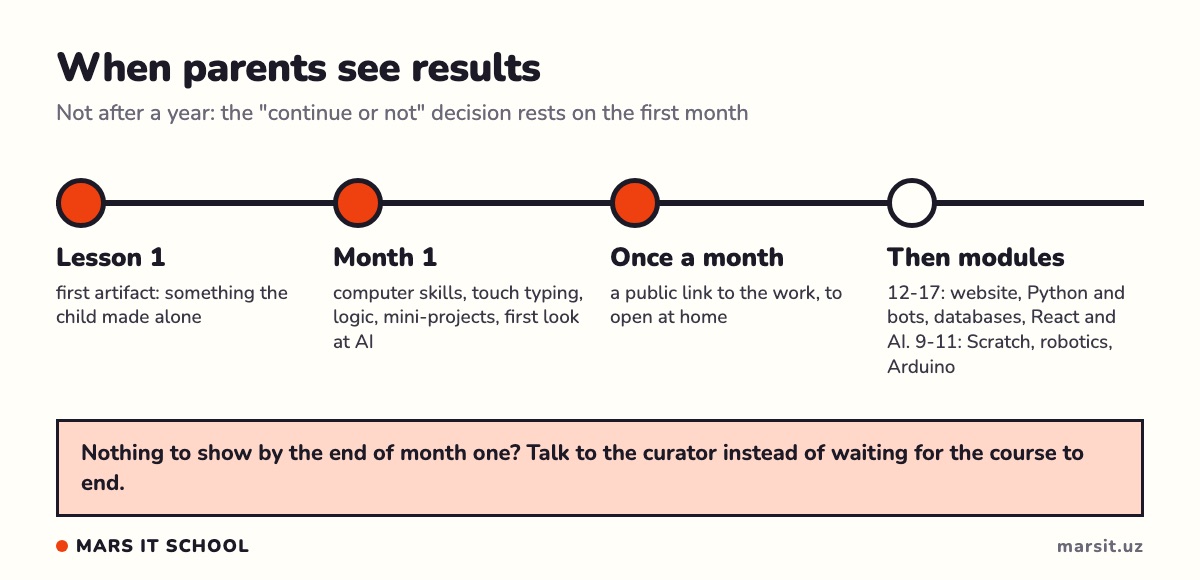
One month gives a start, not a skill. So the first month is separate, mandatory and called "AI-Pilot": the child learns their way around a computer and touch typing, solves logic puzzles, makes first mini-projects and meets AI. By the end there is something to show, and you decide whether to continue on results, not promises.
After that come modules of three months. For ages 9-11 the path goes through Scratch (designed primarily for ages 8-16) to robotics and Arduino. For ages 12-17: a first website, Python and Telegram bots, then databases, React and AI. The first three modules are a 9-month base cycle; the rest, up to 24 months, are follow-on tracks.
What that means in hours
- 12 lessons a month are included in the fee;
- each lesson is 60 minutes;
- 12 hours a month in total, about three hours a week;
- homework is 20-40 minutes and continues what the child did in class.
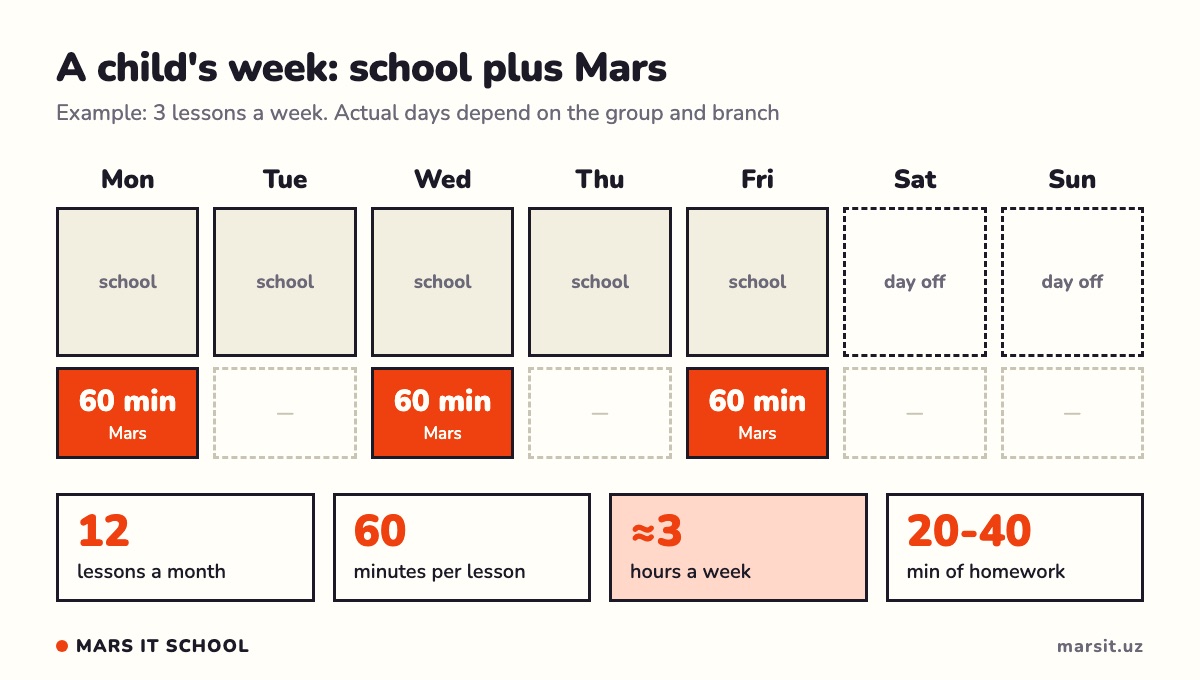
A group of 8-12 kids meets about three times a week. Exact days depend on the branch and group, so a manager picks the schedule with you.
Why a lesson doesn't turn into a lecture
Tiredness after school is a real problem, and the lesson is built around it. For 80% of the time the child works on their own, and each lesson has one new idea. Continuous work is capped at 25-30 minutes for ages 12-17 and 15 minutes for younger kids, then the activity changes. Every lesson follows one skeleton: a short hook, recap, a new idea, practice, a mini-quiz, a second practice, a show-and-tell.
Every lesson ends with an artefact: a page, a mini-game, a bot, something the child made and can show. Once a month the artefact is public, with a link you can open at home. The idea is not ours: the MIT team behind Scratch writes that digital fluency means designing, creating and remixing, not only browsing and chatting (Resnick et al., 2009). On the MarsHub platform you can see that kind of work, such as a touch-typing trainer for Uzbek words at typingclub.marshub.uz.
When you see results
Not after a year. The first artefact appears in the first lesson, the first mini-projects during "AI-Pilot", and a public link to your child's work comes once a month. If by the end of the first month the child cannot show anything, talk to the curator then, rather than waiting for the course to end.
What a parent can do
- Pick a slot for the child, not for yourself. If they come home from school drained, take a later slot after rest. If weekdays are taken by a tutor, ask for a weekend group.
- Don't load everything at once. Start with "AI-Pilot": one month shows how your child copes with the schedule.
- Know who does what. A tutor works next to the teacher in class; attendance and progress are handled by the curator, your contact at the school.
- Don't fear absences. The mentor goes through a missed topic with the child separately, and the materials and recording stay in their Space profile.
- Start with a trial lesson. The seat is prepaid, and if your child doesn't stay, the prepayment is refunded.
When the course is not a fit
If your child already has three tutors and exam prep, a fourth commitment is too many. Better to postpone: "put off for later" is also a frequent reason in our enquiries, and you can return with the next intake. There are no instalments; payment is monthly. A child dragged to class against their will will not learn to program.
Parents' questions
How long does the whole programme last?
Up to 24 months, in modules of three months. The base cycle is the first three modules, 9 months.
How much time per week does it take?
About three hours: 12 lessons of 60 minutes a month, plus 20-40 minutes of homework after each.
Can a missed lesson be made up?
Yes. The mentor goes through the topic separately; materials and the recording stay in the child's Space profile.
Programmes: AI Kids for ages 9-11 and AI Pilot for ages 12-17. How a lesson is built is in the methodology. You can book a trial lesson via the application form.
Sources
- AI Pilot programme page — marsit.uz/en/courses/it-development
- AI Kids programme page — marsit.uz/en/courses/ai-kids
- Mars methodology: the 60-minute lesson structure — marsit.uz/en/courses/methodology
- Resnick et al., "Scratch: Programming for All" (MIT Media Lab, CACM 2009) — web.media.mit.edu/~mres/papers/Scratch-CACM-final.pdf
- Scratch is designed primarily for ages 8-16 — en.wikipedia.org/wiki/Scratch_%28programming_language%29
- Arduino Education — www.arduino.cc/education