What age to start learning programming?
Mars takes children from age 9. How the 9-11 and 12-17 groups differ, what application data shows, a home readiness check, and what to do before age 9.

In short:
- Mars takes children from age 9: AI Kids is for ages 9-11, AI Pilot for ages 12-17;
- parents most often decide at 12-14 (2,786 applications in six months), but 15-17-year-olds also start from zero;
- under 9 a formal course is not needed: logic games and free Scratch at home are enough.
Mars takes children from age 9. Before that a formal course is usually unnecessary: logic games and a first look at Scratch at home are enough. Starting later is not too late: among our applications over six months, more than a thousand were for ages 15-17. No programming knowledge is required in any group.
Below: what really differs between the age groups, and how to check your child's readiness in one evening.
What we see in applications
From lead forms over six months (about 5,650 applications with an age given):
- ages 12-14: 2,786 applications, the most common starting age;
- ages 15-17: 1,305;
- ages 9-10: 505;
- age 11: 494.
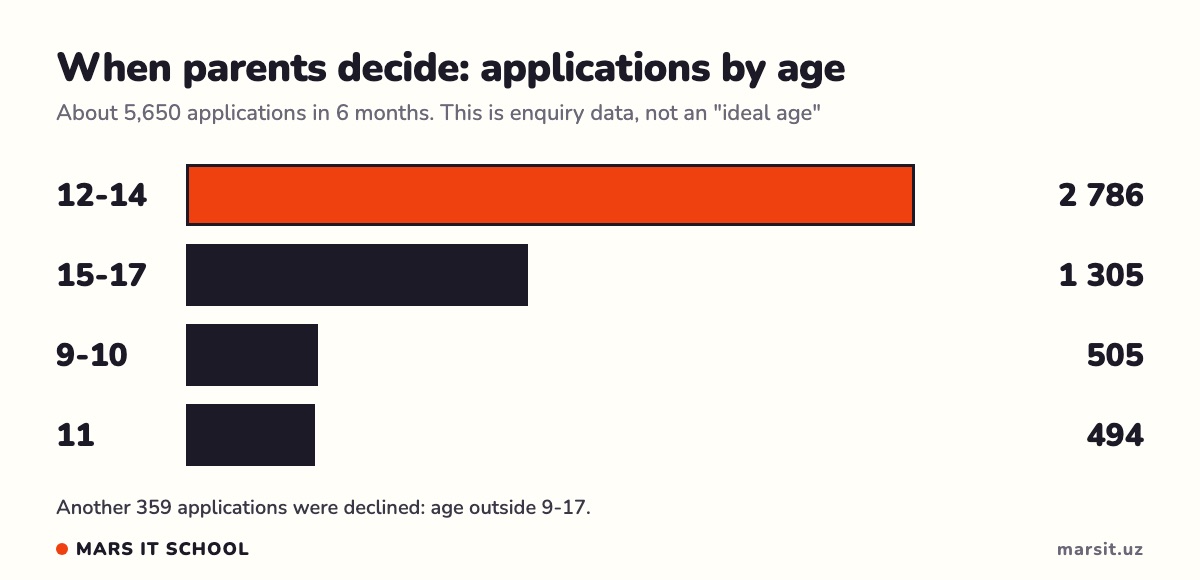
Parents most often worry not about "too early" but about "too late": in managers' notes the topic of age and level comes up more than any other, about 130 times. This is enquiry statistics, not proof that 13 is the ideal age. It shows when parents decide, not when a child is ready.
How the 9-11 and 12-17 groups differ
The difference is not topic difficulty but how long a child can hold attention. Our lesson standards say:
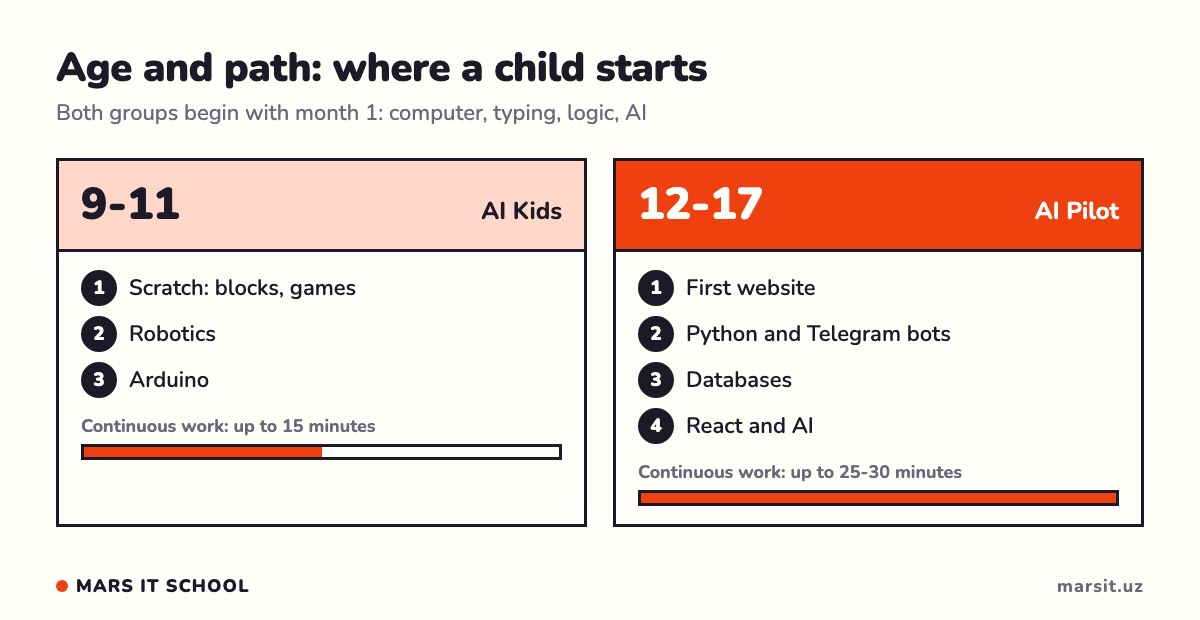
That is why ages 9-11 go through Scratch to robotics and Arduino: first they build what they can see and touch. Scratch itself was designed primarily for ages 8-16. At 12-17 the programme leads to real code: a first website, Python, Telegram bots, databases. Lessons are 60 minutes for everyone, in groups of 8-12.
Checking readiness at home
This is not our test or a scientific method, just three practical questions:
- Does your child read fluently? They will have to read on-screen instructions themselves.
- Can they stay on one task for 15 minutes? If yes, the 9-11 group fits. If not, practise at home with games and construction sets and come back later.
- Do they like building, not only playing? Construction sets, Minecraft builds and "how to make" videos are a good sign.
You do not need to know touch typing or the computer in advance. The first month, "AI-Pilot", is exactly about that: files and folders, touch typing, logic, first mini-projects, meeting AI.
If your child is 14-17 and feels "late"
Most likely not: we get more than a thousand applications for ages 15-17. A teenager starts with projects for their age: a site, a bot, their own service. On the MarsHub platform, work is published at personal addresses like name.marshub.uz, and there are more than 200 such sites; one example project is the space quiz at cosmo-owl.marshub.uz. For teenagers there is AI Pilot: the first lines of code are written in the introductory lessons and no prior knowledge is needed.
What to do before a course
If your child is 5-8, preparation is what children already like:
- logic games and puzzles, including board games;
- construction sets, built both from a diagram and from their own idea;
- free Scratch on a computer: blocks snap together like bricks, no typing code;
- the habit of finishing what you start: build, show, explain.
None of these replaces a course, but by 9 a child arrives with interest, not from zero. If your child is nearly 9, book a trial lesson and the manager will decide with you which group fits.
Parents' questions
Is 7-8 possible?
We take children from age 9. Before that, start at home with Scratch, board logic games and construction sets.
Is 15-17 too late?
No. We get more than a thousand applications for ages 15-17 in six months, and no programming knowledge is required.
Does my child need touch typing first?
No. They learn touch typing in the first month, "AI-Pilot".
Choosing a course by age: course finder, AI Kids 9-11, AI Pilot 12-17. To see how it works in practice, leave an application for a trial lesson.
Sources
- Scratch is designed primarily for ages 8-16 — en.wikipedia.org/wiki/Scratch_%28programming_language%29
- Arduino Education — www.arduino.cc/education
- AILit Framework (OECD and European Commission): AI literacy for primary and secondary education — ailiteracyframework.org/
- AI Kids, ages 9-11 — marsit.uz/en/courses/ai-kids
- AI Pilot, ages 12-17 — marsit.uz/en/courses/it-development