AI for kids aged 12-14: what Mars lessons teach
Which AI topics a 12-14-year-old covers at Mars: intro in the Pilot month, AI services and prompts in module 3, how a lesson works, and trial-lesson questions.

Abbosxon Xamidov, mentor at Mars IT School
Founder of aisolution.uz, teaches the AI-Pilot course
In short:
- AI at Mars is not a standalone "chat with a neural network" subject: the introduction comes in the first month, "AI-Pilot", while connecting AI services and working with prompts sits in the third module, months 7-9;
- the main rule in every lesson: the child is the author, AI is a tool, and the student must be able to explain every line the AI wrote;
- we do not promise a "neural network specialist" career, but by the end of the base cycle the child has a project with a database and an AI feature.
Parents of 12-14-year-olds ask: "Will you teach them to use ChatGPT?" We answer differently. Kids can already use a chatbot; what needs teaching is how to build AI into their own project and how to check what it answers. That is what the AI part of the AI Pilot programme consists of, and 12-14-year-olds take it too: it is shared across ages 12-17.
Below are the concrete topics with sources, how AI appears in an ordinary 60-minute lesson, and what to ask at a trial.
Which AI topics a child covers
- First month, "AI-Pilot". A block called "Meeting AI": what AI is, how it works, practical examples. Alongside come touch typing, logic and first mini-projects. The aim is to understand the tool before relying on it.
- Modules 1 and 2 (months 1-6): AI as a helper under the author rule. The child builds a first website, then writes a Telegram bot in Python. AI is allowed as a guided step, and the methodology rule applies: "explain every line the AI wrote". A demo of the "look, the AI did it all" kind is banned in our lessons.
- Module 3 (months 7-9): AI in a project. Databases and SQL, React, Git, plus connecting AI services to a project and working with prompts. The module ends with a project that has a database and a presentation at Demo Day.
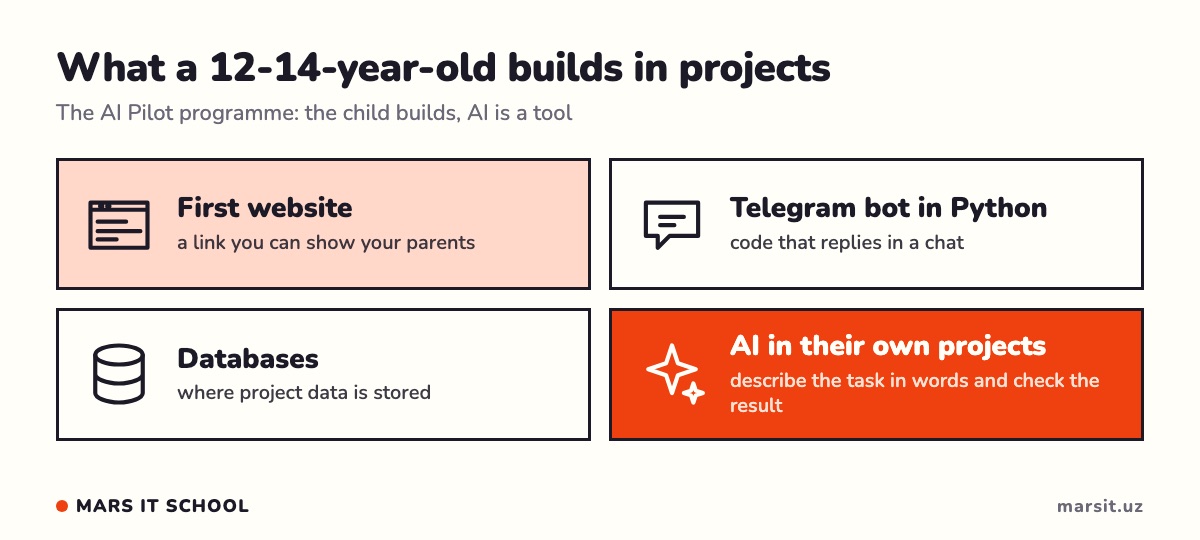
So at ages 12-14 the main AI block does not come in the first lesson; it comes after the child can already build a site and a bot. That is deliberate: first they understand what they are building, then they speed up with a tool.
How AI shows up in an ordinary lesson
By the standard, a lesson runs 60 minutes:
- Recap, 4-5 minutes. Kids recall rather than re-read.
- One new idea, 7-8 minutes, with a live example from the teacher.
- Practice I, 18-22 minutes. A worked example, then a partial one, then their own variation. Hints instead of ready-made solutions.
- Mini-quiz, 3-5 minutes, checking understanding.
- Practice II, 13-17 minutes. Their own function in the project, pair work, or a guided step with AI.
- Finale, 4-5 minutes: showing the work, homework, a teaser.
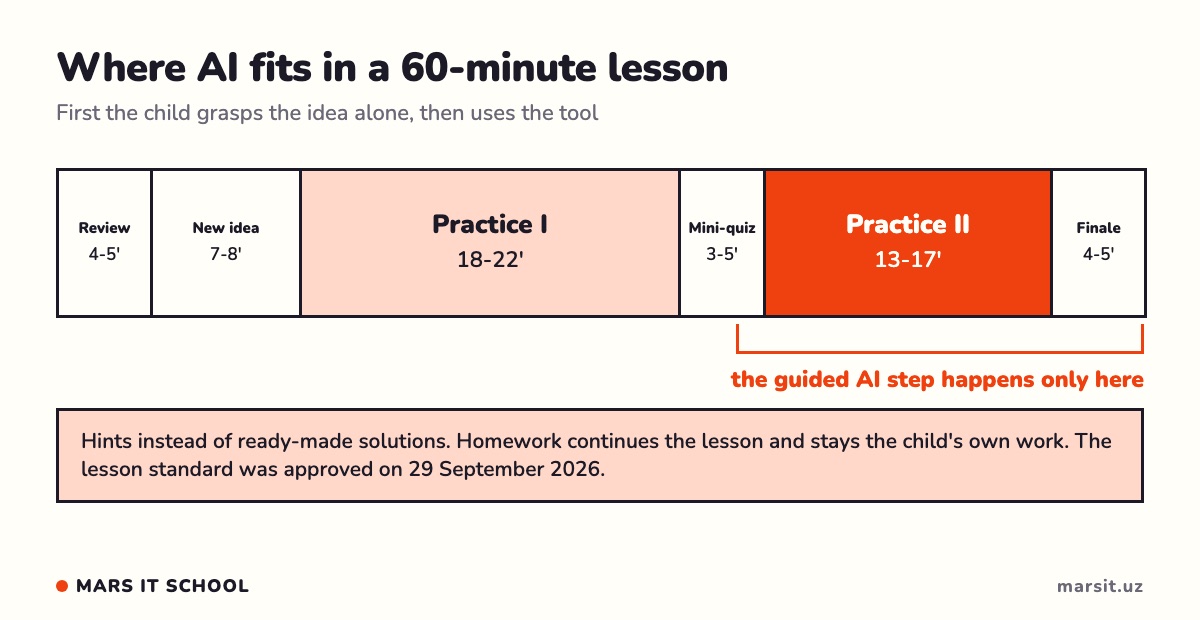
AI takes part of the last practice block, not the whole lesson. In a group of 8-12, the teacher and tutor have time to see what exactly the child asks the AI and what they do with the answer. The lesson standard was approved on 29 September 2026 and published on the "Methodology" page.
What is said about AI literacy
The OECD and the European Commission published the AILit framework for primary and secondary education. By it, AI literacy means understanding how AI systems work, critically evaluating their opportunities and risks, and using them responsibly. Our topics follow the same order: first "how it works" in the "AI-Pilot" month, then "check and explain" in every lesson, then "build it into your project" in the third module.
What we do not promise
- We do not promise that a child will become a "neural network specialist" after the course.
- We do not promise employment or name salaries.
- We do not claim AI will or will not replace programmers: nobody knows.
- We do not control what a child does with AI at home. Talk about which services they use and what personal data they type into them.
How to check at home that your child understands
Ask them to show their latest work in five minutes and explain what each part does. If they can say what happens when one line changes, they understand rather than copy. If the answer is "the AI wrote that", bring it up again at the next lesson and discuss it with the curator. A lesson's artefact should be their own work, one they can defend. Homework always continues the lesson: 20-40 minutes, and it is their own work.
Parents' questions
Will my child just copy from AI?
The methodology rule bans showing AI output without understanding it: the student explains every line. In practice, hints replace ready-made solutions.
Is it suitable if my child knows nothing?
Yes. No prior knowledge is needed; the first lines of code are written in the introductory lessons.
At what age does AI start?
AI Kids for ages 9-11 goes through Scratch to robots and Arduino. Connecting AI services to a project sits in the 12-17 programme, in the third module.
What to ask at a trial: which part of the lesson the child works with AI and which part alone; what they will bring home; how you will know they understood rather than merely received an answer. Programme: AI Pilot for ages 12-17, methodology. You can sign up through the application form.
Sources
- AI Pilot: course topics, the "Databases, React and AI" module — marsit.uz/en/courses/it-development
- Mars methodology: "The child is the author, AI is a tool" — marsit.uz/en/courses/methodology
- AILit Framework (OECD and European Commission), AI literacy — ailiteracyframework.org/
- Telegram Bots, official documentation — core.telegram.org/bots
- Python for beginners (python.org) — www.python.org/about/gettingstarted/